
Ontario’s online casinos have grown from a bold experiment into one of the largest regulated markets in North America, and players in the province have gained a lot along the way. Since April 4, 2022, private brands have competed under one set of provincial rules. A regulator watches them, and every account comes with tools that help players stay in control.
Four years is long enough to judge the results. The numbers are large, the protections are real, and a few gaps remain. This essay looks at all three, using the market’s own published data.
Four Years in Numbers
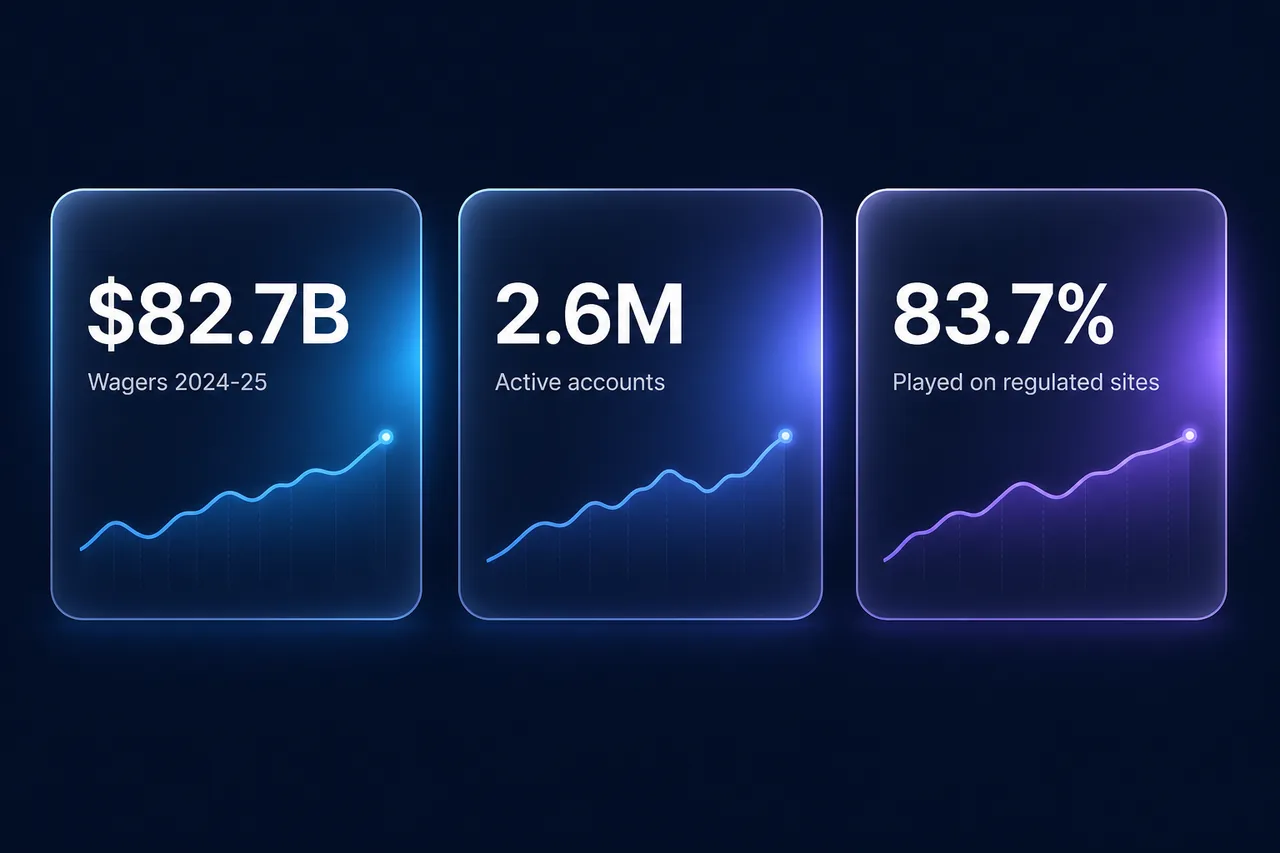
The table gathers the headline figures from iGaming Ontario’s 2024-25 annual report and other published sources. Each one tells a part of the story.
| Measure | Figure | Period |
|---|---|---|
| Market opened | April 4, 2022 | Launch date |
| Total wagers | $82.7 billion | Fiscal 2024-25 |
| Total gaming revenue | $2.9 billion | Fiscal 2024-25 |
| Active operators | 50 | End of fiscal 2024-25 |
| Gaming websites | More than 80 | Fiscal 2024-25 |
| Active player accounts | 2.6 million | Fiscal 2024-25 |
| Dividends to the province | $181 million | Fiscal 2024-25 |
| Players reporting regulated play | 83.7% | Survey, early 2025 |
Wagers grew by roughly a third in a single year. The 2.6 million figure counts accounts rather than people, since one person can hold accounts with several operators, but it still shows how many Ontarians have chosen the regulated route.
From Launch Day to a Mature Market
The market did not arrive fully formed. It has been shaped year by year, with each step adding something for players. The milestones below trace that path.
- April 2022: the regulated market opens, with private operators joining iGaming Ontario’s system.
- August 2023: the AGCO fines an operator $100,000 over alleged failures to protect a high-loss player.
- February 2024: athletes and celebrities likely to appeal to minors are banned from gaming ads.
- November 2025: the Court of Appeal backs shared international play for games such as poker.
- May 2026: BetGuard launches, letting players exclude themselves from every regulated site at once.
- July 2026: Alberta opens its own regulated market, following Ontario’s lead.
Each step answered a weakness critics had raised. Taken together, they show a market that has kept adjusting rather than standing still after launch.
Where the Money Comes From
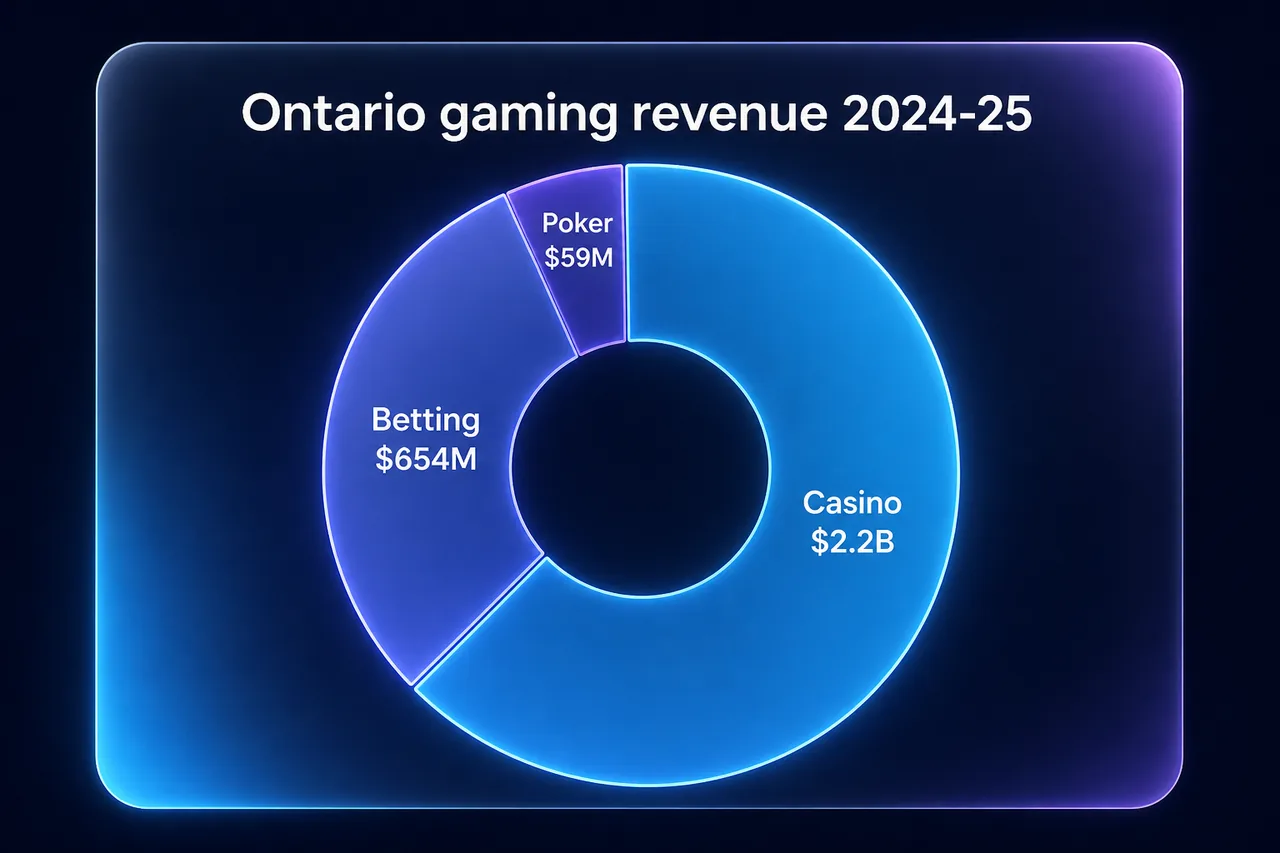
Casino games dominate. In fiscal 2024-25, online casino play produced $2.2 billion of the market’s $2.9 billion in gaming revenue, roughly three quarters of the total. Betting added $654 million, and peer-to-peer poker $59 million.
Wagers Versus Revenue
The two headline numbers measure different things. Wagers are the total amount players bet, and the same dollar counts again each time it is staked. Gaming revenue is the amount operators hold on to once winnings have been paid.
Example. In June 2026, Ontario players wagered C$9.46 billion, while operators held on to C$400.6 million after paying winnings. In other words, a little over 4 cents of every dollar staked stayed with the operators that month, by simple division of the published figures.
That ratio is a reminder of how the business works. Most money staked flows back to players as winnings, but across the whole market, players as a group lose over time.
Who Runs What in Ontario’s System
Part of the market’s strength is a clear split of roles. Two public bodies share the work, and each operator signs on to both.
- The AGCO registers operators and enforces the written standards for internet gaming.
- iGaming Ontario runs the market day to day and holds an operating agreement with every brand.
- Private operators run the sites and carry the duty to protect their players.
- OLG’s own sports product sits inside the same self-exclusion program as the private brands.
For a player, the practical upshot is simple. A site with the iGaming Ontario logo has passed both gates, and it answers to Ontario’s rules every day it stays open.
Inside the 2.6 Million Accounts
The count of 2.6 million active accounts sounds like a count of people. It is not. Many Ontarians hold accounts with two or three brands, often to compare games or offers.
That habit has a side effect worth knowing. Limits you set on one site do not carry over to another, because each operator runs its own account. Province-wide self-exclusion is the only tool that reaches every brand at once.
Tip. If you hold several accounts, set the same deposit limit on each one. Better still, close the ones you no longer use, so your spending stays in one place you can see.
What Players Have Gained
For individual players, the biggest change since 2022 is not the number of brands. It is the safety net that now sits under every licensed account.
- Every regulated site must offer deposit, loss and time limits.
- A single provincial program can exclude a player from every regulated site.
- Complaints have a formal route, with a regulator behind the operator.
- Advertising follows written rules, including limits on who can appear in ads.
- The iGaming Ontario logo makes it easy to tell a regulated site from an unregulated one.
Awareness is improving too. iGaming Ontario reports that 71.5% of players knew about responsible gambling tools in 2024-25, up from 65.4% a year earlier. The Responsible Gambling Council now tells Ontario residents plainly to use licensed iGaming Ontario sites, because those sites include responsible gambling features.
How Ontario Online Casinos Compete for Players
In many markets, casinos compete with loud bonus ads. Ontario took a different path. Bonuses and credits can be promoted only once a person is on a licensed site or app, or through direct marketing to customers who agreed to receive it. Public bonus ads are not allowed, even from affiliate partners.
That rule pushes competition toward things players can judge for themselves once they arrive.
- The size and quality of the game library.
- How fast and smoothly withdrawals are handled.
- How clear the terms are on any offer.
- How easy it is to find and use the limit tools.
It is a quieter form of competition, but it suits players. A site has to earn loyalty through the experience rather than through a billboard.
Advertising Rules That Changed the Conversation
In the early months, Ontario’s airwaves filled with gambling ads, many featuring sports stars. The regulator responded. From February 28, 2024, the AGCO banned the use of active or retired athletes in internet gaming marketing.
The rule also covers famous faces that tend to attract children and teens. Athletes can still appear in responsible gambling messages, which keeps a useful voice for safety campaigns.
Good to know. If an ad still bothers you, Ontario’s regulator handles complaints about how operators advertise. Questions about how often ads run go to broadcast bodies rather than the gaming regulator.
What a Typical Evening Looks Like on a Licensed Site
For most players, the rules fade into the background. Here is how they show up on a normal night. You sign in. The site checks that you are in Ontario. Your deposit limit sits quietly in your account. You play a few games, and every bet goes into your history.
If you hit your limit, the site stops you. If you want a break, a time-out or BetGuard is a few taps away. If something goes wrong, you have a complaint route with a regulator behind it. None of this gets in the way of a fun night, yet all of it is there when you need it.
Enforcement With Real Consequences
Rules matter only if someone enforces them. A clear example came in August 2023, when the regulator fined one operator $100,000. Among the alleged failures, the operator had not stepped in when a player lost more than $2 million in under four months.
The regulator’s toolkit includes warnings, suspensions and monetary penalties. It cannot recover money for an individual player, but it can change how an operator behaves, which protects everyone who plays on that site afterwards.
The Province’s Share
A regulated market also returns money to the public. In fiscal 2024-25, iGaming Ontario paid dividends of $181 million to the Province of Ontario.
That figure is one reason other provinces are paying attention. Money spent on unregulated sites leaves the province entirely, while money spent on licensed sites returns a share to Ontario.
A Single Switch to Step Away
For years, self-exclusion in Ontario meant contacting each site separately. That changed in May 2026, when iGaming Ontario launched BetGuard.
One sign-up with valid ID now blocks a player from every regulated site, including OLG’s Proline. The menu runs from six months to five years, with one year in between and a custom choice as well. Once it starts, an exclusion can grow longer but never shorter.
Note. Anyone 19 or over can register. The program covers regulated sites only, so it cannot block offshore brands.
Why Some Players Still Play Elsewhere
The market’s biggest gap is the share of play that never entered it. In iGaming Ontario’s early 2025 survey, 83.7% of players said they played on a regulated site. A year earlier the figure was 86.4%, so the share slipped rather than grew.
Outside estimates point in the same direction. Lawyers at BLG estimate that about 20% of Ontario online gaming still happens on unregulated sites. The two figures measure different things, one counting players and the other activity, but both show a sizable group outside the system.
What Could Bring Them In
Nobody knows for sure why each player stays outside. Analysts point to a few likely reasons. Some offshore poker rooms have bigger fields, some brands were familiar long before 2022, and some players simply do not know which sites are licensed.
Each of those reasons has a fix. Shared poker pools, clearer labels and more public awareness could all help. Awareness of safety tools already rose in a single year, which suggests the message can spread.
Why It Matters to Players
A few signs suggest a site sits outside Ontario’s system.
- There is no iGaming Ontario logo, and the brand is missing from the official directory.
- The site accepts you from anywhere, with no location check.
- Bonus offers are pushed at you in public ads or social posts.
Warning. Money you lose on an unregulated site has no Ontario complaint route behind it, however professional the site looks.
A player on an unregulated site gives up every protection listed above. There is no provincial self-exclusion, no AGCO complaint route and no Ontario standard for limits or identity checks. Each player who moves into the regulated market gains those protections at once.
What the Court Ruling Could Add
One reason some players look elsewhere is poker. Ontario’s poker tables have been limited to players in the province since launch, which means smaller fields than international sites offer.
In November 2025, the Court of Appeal for Ontario ruled 4 to 1 that a model allowing play with people outside Canada would be lawful. Provincial lottery corporations appealed, and the Supreme Court of Canada heard the case on October 7, 2026. Its decision was still pending at the time of writing.
Note. If shared play eventually arrives, analysts expect it to draw some players back to regulated sites. That would extend the market’s protections to more people without lowering any standard.
A Look at Recent Monthly Records
Growth has not slowed in 2026. In June of that year, Ontario players wagered C$9.46 billion, up 30.3% from C$7.26 billion a year earlier. Gaming revenue reached C$400.6 million, up 30.6%.
Fast growth is good news for the market’s finances. For individual players, it is a reason to keep an eye on their own habits, because a busy, convenient market makes it easy to play more than planned.
How Alberta Is Following Ontario’s Lead
Ontario’s model is now spreading. On July 13, 2026, Alberta launched a licensed market of its own under the iGaming Alberta Act. Like Ontario, it uses a regulator plus a separate agency that manages the market.
For players across Canada, that is a sign the Ontario approach is seen as workable. It also opens the door to cooperation, including talks between the two provinces about a shared poker pool.
Lessons Other Provinces Are Watching
Ontario’s results now shape debates elsewhere. In Quebec, a coalition of online operators has asked the province for an Ontario-style licensing system with an independent regulator and a central self-exclusion program. In Atlantic Canada, the public lottery corporation’s leaders estimate the region loses about $200 million a year to untaxed online gambling.
- Licensing private brands can bring play onto sites with provincial protection.
- A central exclusion program needs every operator inside one system.
- Clear advertising rules can limit the reach of gambling ads to young people.
Not every province will copy Ontario. Each one decides its own model under the Criminal Code. Still, four years of public data give every province a real example to study.
Myths About the Regulated Market
Four years in, a few myths still circle around Ontario’s market. Each one is easy to check against the facts.
- “Licensed sites pay out less.” The cost of a game comes from its rules, and licensed sites must show those rules before you play.
- “Offshore sites are just as safe.” They may be well run, but no Ontario complaint route or exclusion program reaches them.
- “Self-exclusion is only for people in crisis.” It is a tool for anyone who wants a firm break, for any reason.
- “More ads mean no rules.” Ontario limits who can appear in ads and bans public bonus ads.
Myths like these keep some players away from the protections they would want. Checking a site’s status takes a minute and settles the question.
Does Ontario’s Model Serve Players Well?
On balance, yes, with clear room to improve. The table sets out the strengths and the open questions after four years.
| What works for players | What still needs work |
|---|---|
| Limits and self-exclusion built into every account | About one in six players still reports playing elsewhere |
| A regulator that fines operators for failures | Individual disputes still rely on the operator to settle |
| Advertising rules that protect young people | Ad volume remains a common complaint |
| Wide choice of licensed brands and games | Poker pools are small while the appeal is pending |
None of the gaps undo the gains. They mark the next tasks for a market that has already shown it can adjust.
What Ontario Players Can Do Today
The protections described here only help if players use them. A few minutes of setup makes the regulated market work in your favour.
- Confirm a site carries the iGaming Ontario logo and appears in the official directory.
- Set deposit, loss and time limits as soon as you open an account.
- Review your account history after each session.
- Keep BetGuard in mind if you ever need a firm break.
- Use the formal complaint route if a site breaks its own terms.
Where to Get Help in Ontario
Support is easy to reach in Ontario, and most of it is free. Keep one or two of these in your phone, just in case.
- ConnexOntario takes calls at 1-866-531-2600, as well as texts and online chats, at any hour.
- CAMH offers gambling services for players and families at 416-535-8501, option 2.
- BetGuard blocks access to every regulated site for the period you choose.
- The national 988 line is there for anyone in crisis, by call or text.
A Verdict After Four Years
Four years in, Ontario’s regulated market has delivered what it promised to most players: choice, oversight and real tools for staying in control. A useful companion for making the most of it is www.canada-gambling.com, whose free safer play hub gathers Ontario’s help lines, counselling options and limit rules on one page, alongside the equivalents for Alberta.
The job is not finished while a share of play stays outside the system, but the direction is clear and the benefits are already in place for anyone who chooses a licensed site. Online play in Ontario starts at 19, and if gambling stops feeling like fun, a text to 247247 reaches ConnexOntario day or night.